
AI Tooling
Wall Street vs SaaS: What the AI ‘Agent Layer’ Selloff Really Means
A wave of selling hit enterprise software names after new AI automation tooling raised ‘subscription replacement’ fears. Here’s what’s real, what’s hype, and how SaaS leaders should respond.
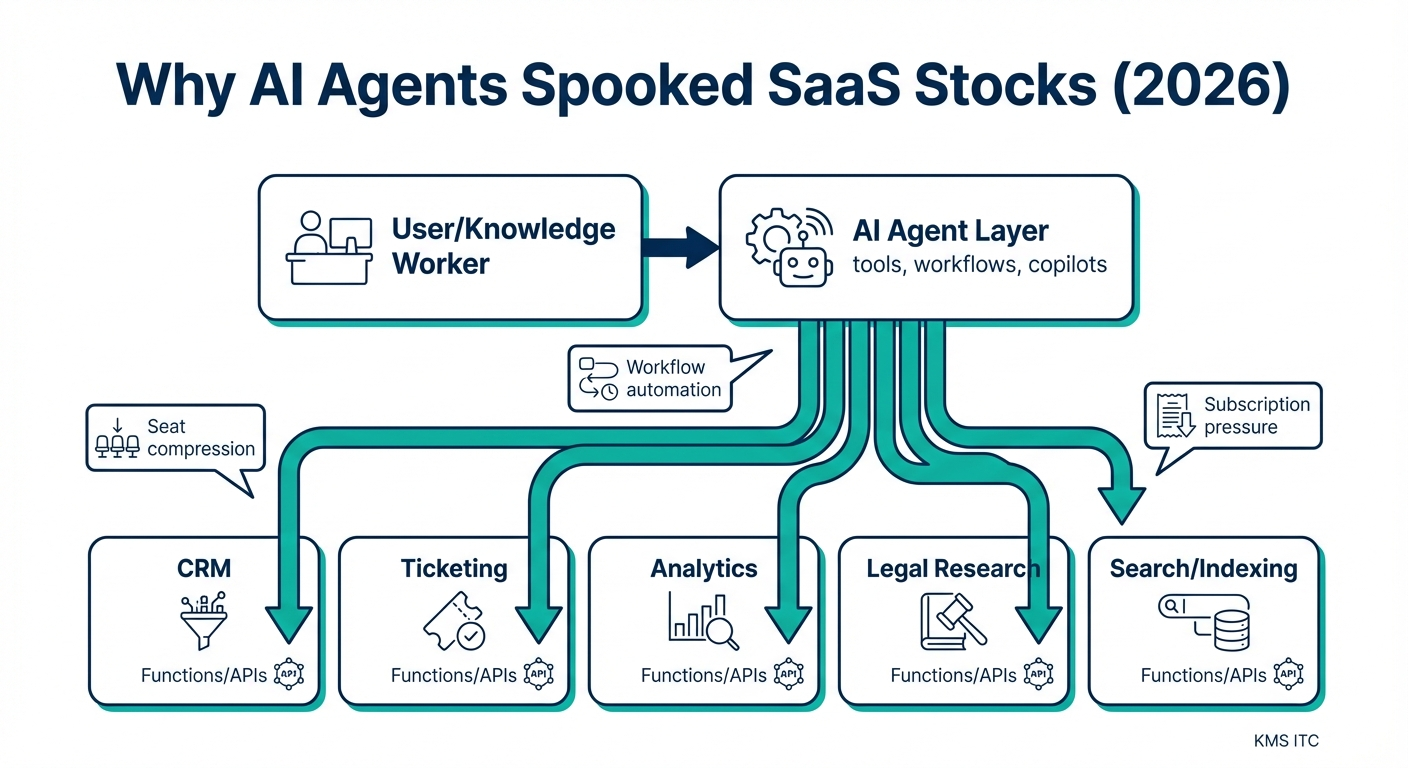
A sharp selloff in enterprise software stocks this week is being framed as a simple story: AI is going to replace SaaS.
The catalyst (as reported by The Information) was fresh anxiety that AI automation tools—specifically legal-task automation—could reduce demand for traditional subscriptions. A number of enterprise software and data/analytics names fell hard in a single session.
Even if you ignore the day-to-day market noise, the underlying question is worth taking seriously:
If an AI agent can do the work, what happens to seat-based software?
The real architectural shift: an “agent layer” on top of SaaS
The most credible disruption thesis isn’t “AI replaces all enterprise apps overnight.” It’s that AI introduces a new interface layer:
- Humans stop clicking through UI for routine work
- Agents call tools/functions/APIs directly
- Some software becomes a back-end capability instead of a seat-heavy product
Why markets react so violently
When investors hear “automation,” they translate it into:
- seat compression (fewer paid users)
- workflow consolidation (one agent replacing multiple tools)
- pricing power erosion (usage-based economics vs annual per-seat)
The truth will be uneven. Some categories are more exposed than others.
What’s likely to be disrupted first
Patterns we’re already seeing:
-
UI-heavy tools with repetitive workflows
- If the product’s value is “click these steps,” agents can learn that.
-
Research/analysis subscriptions (especially where content is commoditised)
- Agents can summarise, extract, draft, and compare faster than humans.
-
Horizontal workflows (tickets, docs, planning)
- If an agent can create tasks, draft PRs, and update docs, the integration layer becomes the product.
What’s harder to disrupt than the headlines suggest
Enterprise systems don’t disappear because of a new interface. They persist because of:
- trusted data (quality, provenance, permissions)
- governance and auditability
- workflow ownership (controls, approvals, segregation of duties)
- operational reliability (SLOs, support, incident response)
Agents don’t magically solve these. They force you to implement them properly.
A practical defensive playbook for SaaS leaders
If you’re building or running a SaaS product in 2026, the move is not “add a chatbot.” It’s to become agent-ready and defend what’s defensible.
1) Agent-ready APIs (function-first)
Treat your UI as optional. Make your product callable by agents safely.
2) Workflow instrumentation
Measure adoption at the workflow level (time saved, throughput, error rate), not just MAUs.
3) Domain data moat
The best defence is high-quality proprietary/curated data that agents can’t cheaply replicate.
4) Trust & governance
Win on security: permissions, audit logs, PII handling, and safe tool execution.
5) Pricing rethink
Seat-based pricing will be pressured. Start experimenting with usage/value pricing and bundles.
The KMS ITC take
The market headline is “AI kills SaaS.” The more accurate engineering headline is:
AI shifts value from “UI + clicks” toward “APIs + data + governance + measurable outcomes.”
Some vendors will be disrupted. Others will become even more essential—because they are the systems of record and control.
Sources
- The Information (briefing): https://www.theinformation.com/briefings/wall-street-dumps-software-stocks-ai-disruption-fear-lingers
- Reuters coverage (index page / JS-gated in some regions): https://www.reuters.com/business/media-telecom/global-software-stocks-hit-by-anthropic-wake-up-call-ai-disruption-2026-02-04/