
AI Architecture
Evaluation is the control plane for enterprise GenAI: what Bedrock Evaluations implies for architecture and operating model
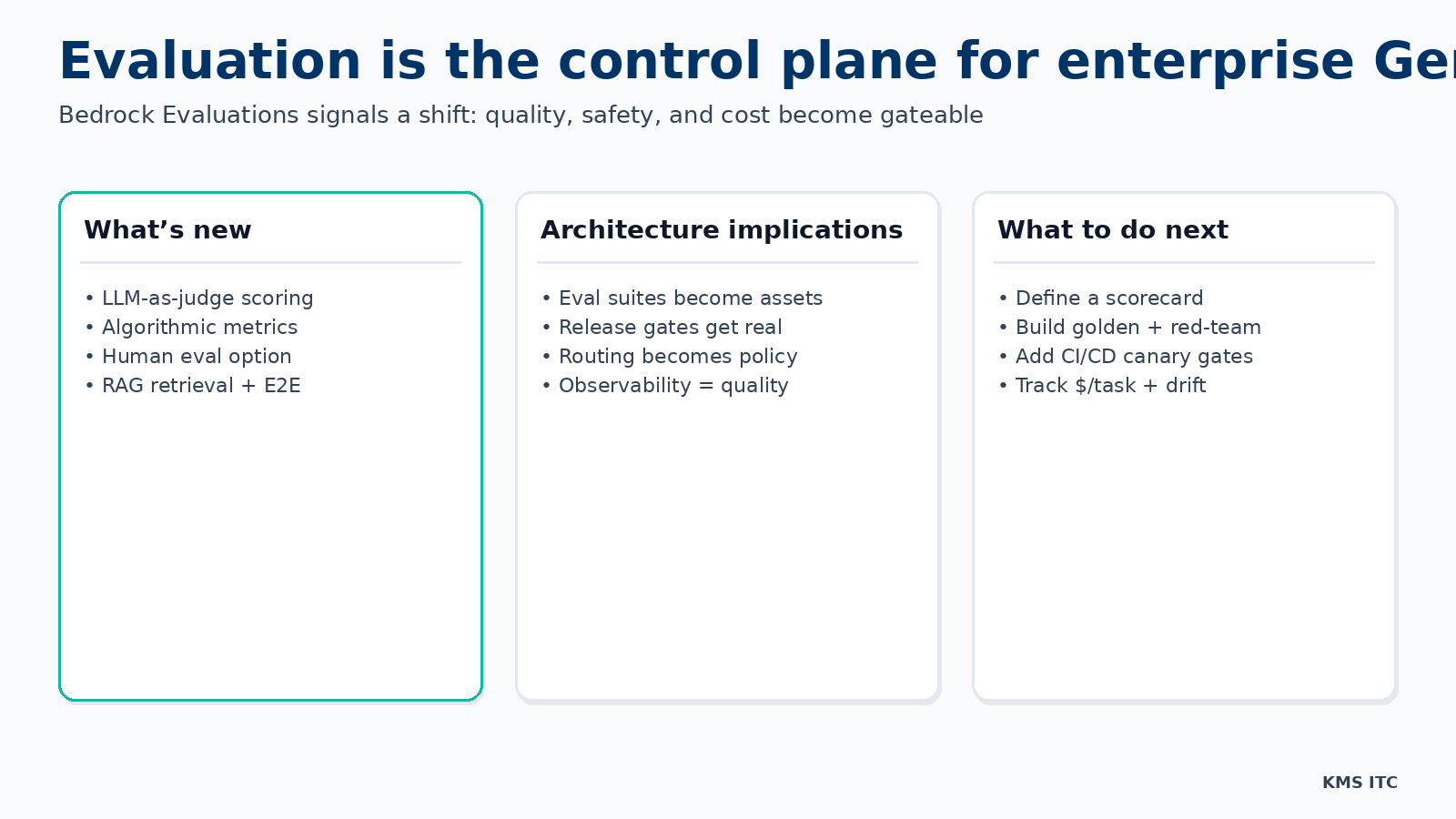
When evaluation becomes a managed capability (LLM-as-judge, algorithmic metrics, human review, RAG scoring), you can finally gate GenAI changes like software releases. Here’s the reference architecture and tradeoffs.
Most enterprise GenAI programs hit the same wall:
- The demo works.
- The pilot works most of the time.
- Then a small prompt/model/RAG tweak ships… and trust collapses.
Traditional software has a control plane: CI, tests, release gates, canaries, rollbacks.
GenAI needs the same thing, but the “tests” are fuzzier: quality, hallucination risk, safety constraints, latency, and cost-per-task.
AWS’ Bedrock Evaluations is a signal worth paying attention to: evaluation is moving from “spreadsheet + vibes” to a platform primitive you can standardise, automate, and govern.
1) The capability jump (what matters, not the feature list)
Bedrock Evaluations packages a set of evaluation modes that map cleanly to enterprise needs:
- LLM-as-judge scoring for correctness/completeness/harmfulness
- Algorithmic NLP metrics (e.g., exact match-style and similarity-style measures)
- Human evaluation workflows when you need calibrated judgement
- RAG-specific scoring (retrieval quality and end-to-end response quality)
That mix matters because enterprises don’t have “one kind” of risk.
Some outputs can be validated mechanically. Some require a judge model. Some require a human.
If you can’t combine these consistently, you can’t operate GenAI at scale.
2) The architecture implication: you need an evaluation control plane
Treat evaluation as shared infrastructure, not a per-team side quest.
The key design move
Separate two planes:
- Application plane: your RAG apps, agents, workflows, UIs, APIs
- Control plane: evaluation suites, scoring, trace capture, release gates, routing policy
Once you do this, a lot of “GenAI chaos” becomes normal platform engineering:
- teams propose a change (prompt, retrieval chunking, model swap, tool policy)
- the control plane evaluates it against agreed thresholds
- releases are gated, canaried, and rolled back based on real signals
3) The tradeoffs (what will bite you if you don’t design for it)
Tradeoff A: LLM-as-judge can be wrong (and biased)
Judge models are useful, but they’re not truth.
Mitigations:
- use multiple judges for high-stakes classes (or sample + human audit)
- keep a small human-calibrated set as an anchor
- track judge drift like any other dependency
Tradeoff B: evaluation cost is real
If you score every request, you’ll pay for it.
Patterns that work:
- evaluate per release (candidate vs baseline) with a curated suite
- sample in production for drift detection, not full scoring
- tie evaluation budgets to business criticality (tier-1 workflows get more spend)
Tradeoff C: you need dataset governance (or you’ll leak PII)
Your prompt suites and traces become sensitive assets.
Minimum controls:
- classification + redaction (PII/PHI)
- data residency rules
- retention policy
- access controls and audit logs
Tradeoff D: “quality” is multi-dimensional
If you optimise only for correctness, you may regress latency or cost.
A workable scorecard normally includes:
- task success / correctness
- faithfulness (hallucination risk) for RAG
- safety/harmfulness constraints
- latency (p50/p95)
- $/task and token usage
4) What to standardise in an enterprise operating model
(1) A shared scorecard
Define 6–10 metrics your org will actually gate on.
Example gate policy:
- block release if correctness drops >2% on golden set
- block if harmfulness rises above threshold
- block if p95 latency or $/task increases beyond budget
(2) A “golden set” + a red-team set
You need both:
- Golden set: representative tasks with expected outputs (or expected properties)
- Red-team set: prompt injection attempts, policy bypass, data exfil probes, edge cases
(3) Routing as policy (not hard-coded)
When evaluation exists, model selection becomes a governed decision:
- route by workload class (summarise vs extract vs reason)
- route by data class (public vs sensitive)
- route by cost/latency SLO
(4) Release gates integrated into CI/CD
Make evaluation a step like tests:
- candidate evaluated vs baseline
- publish a scorecard artefact
- require approval for tier-1 workflows
- canary in production with rollback triggers
5) A practical “start this week” checklist
If you want this to be real (not theatre):
- Pick one workflow that matters (customer email drafting, ticket triage, knowledge assistant).
- Create 30–80 prompts (golden + red-team).
- Define a scorecard with thresholds for:
- correctness/success
- safety
- p95 latency
- $/task
- Run a baseline and store the results.
- Add a release gate: “no deploy without scorecard delta.”
The goal isn’t perfection. It’s turning GenAI change from “ship and pray” into measurable iteration.
Sources
If you’re rolling out GenAI across multiple teams and want a lightweight evaluation + release governance model (scorecard, gates, routing policy, and reference architecture), reach out via /contact and we’ll help you stand it up.