
Enterprise Architecture
FEAF vs TOGAF vs Zachman (and friends): How Enterprise Architecture Methodologies Compare—and How to Combine Them
FEAF, TOGAF, Zachman, DoDAF—none of them is a silver bullet. Here’s what each is for, where they break down, and a practical way to use them together without drowning in ceremony.
Enterprise Architecture (EA) methodologies have a reputation problem: they’re either seen as too heavy to ship anything, or too vague to change anything.
The truth is more useful:
- These frameworks aren’t competing “operating systems.”
- They’re different tools for different jobs—taxonomy, governance, modeling, compliance, delivery alignment.
This article compares FEAF, TOGAF, Zachman, and the most common “adjacent” standards (DoDAF/MODAF/NAF, ArchiMate, COBIT/ITIL, SAFe), and then proposes a pragmatic way to combine them.
Executive summary
- FEAF is best understood as a government EA reference model + taxonomy to standardize reporting and cross-agency alignment. It’s stronger on what to classify than how to transform.
- TOGAF is a method (ADM) plus governance concepts. It helps you run an architecture program, but it can become a paperwork factory without strong scoping.
- Zachman is a classification schema (a way to ensure coverage), not a step-by-step method. It’s great for completeness checks, weak for prioritization.
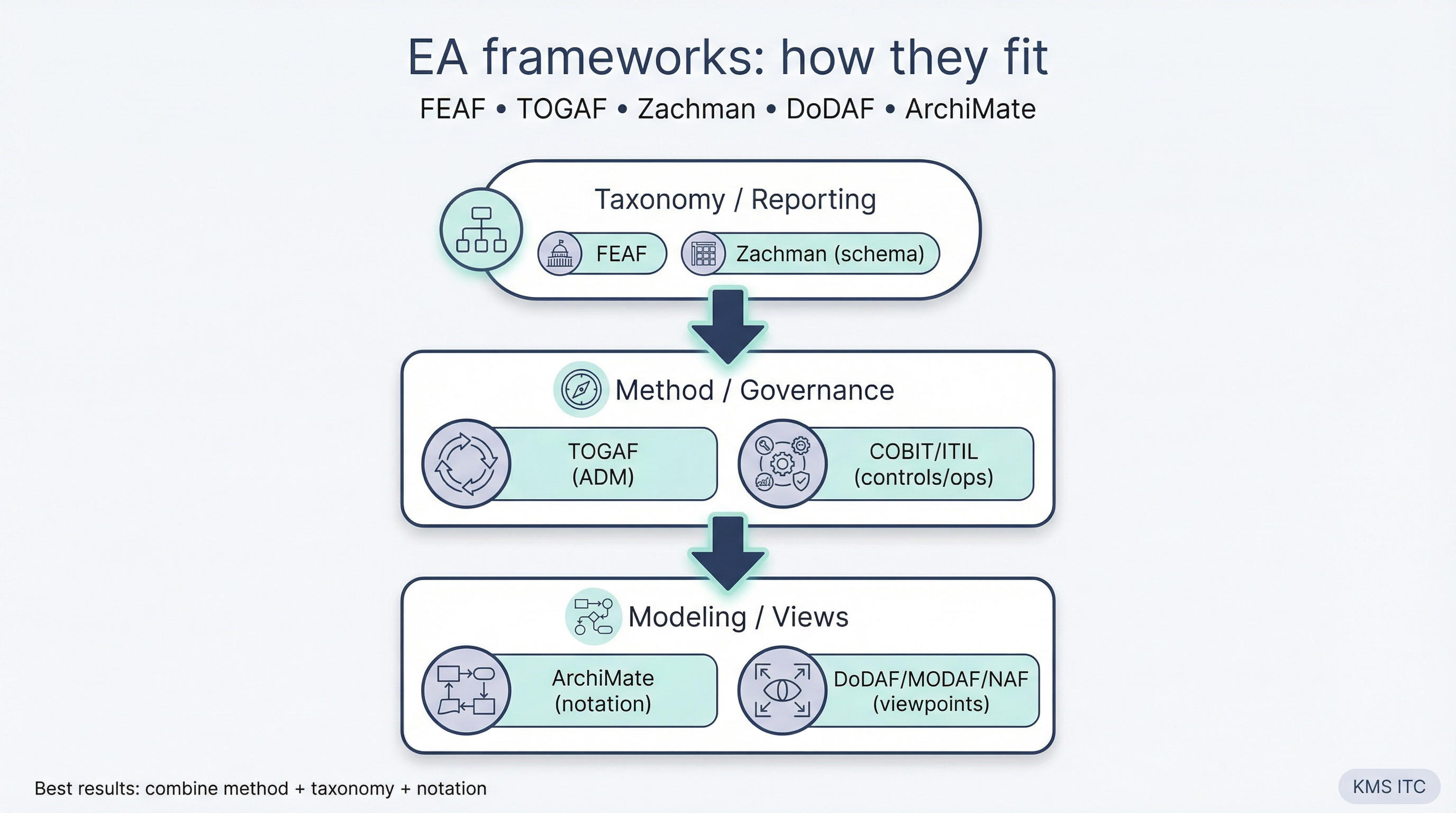
- The winning move is usually a hybrid: choose (1) a method for “how we work” (often TOGAF-lite), (2) a taxonomy for “what we report” (FEAF-like), and (3) a notation for “how we draw” (ArchiMate/C4), then embed it into delivery.
First: what problem are you solving?
A lot of EA pain comes from using a framework for the wrong purpose.
Here are the common EA problem-types:
- Portfolio alignment: Which capabilities do we have, what are we funding, what gets cut?
- Standardization: Can different teams talk about the same thing the same way?
- Target-state design: Where are we heading, and what are the transition steps?
- Governance: How do we keep solutions coherent without blocking delivery?
- Compliance / regulated reporting: Can we defend decisions to auditors/regulators?
- Interoperability: Especially across agencies / business units / vendors.
Different methodologies are optimized for different subsets of the above.
FEAF (Federal Enterprise Architecture Framework)
What it is (in practice)
FEAF is commonly used as a reference framework for US federal agencies to create consistent EA views and map architecture artifacts to shared reference models.
Think: “a shared language and filing system” for architecture across a large federated environment.
What it’s strong at
- Standardized classification of architecture artifacts (useful in big federations)
- Cross-org comparison and reporting
- Encouraging a capability + service view, not just systems
What it’s weak at
- It’s not a highly prescriptive “do this next” transformation method.
- If you treat it as the operating model for delivery, you can end up with compliance artifacts that don’t change real outcomes.
When FEAF is a good fit
- Public sector (or large regulated organizations) where consistent reporting matters
- Multi-agency, multi-division environments where taxonomy is the biggest gap
TOGAF
What it is (in practice)
TOGAF is best known for the Architecture Development Method (ADM): a phased approach (vision → business architecture → information systems → technology → opportunities/migration → implementation governance).
It also brings governance ideas: architecture principles, standards, building blocks, and architecture repositories.
What it’s strong at
- A repeatable method for running an EA practice
- A shared workflow for “architecture work” across business/data/app/tech
- Governance patterns (when done lightly)
What it’s weak at
- Without tight scope, TOGAF becomes “big design up front” with deliverables nobody uses.
- Many orgs copy the ADM phases but skip the hard parts: decisions, tradeoffs, and enforcement.
When TOGAF is a good fit
- You need a process to coordinate architecture across domains.
- You have multiple teams and want consistent “architecture engagement.”
Zachman Framework
What it is (in practice)
Zachman is a 2D schema for describing an enterprise:
- Columns: What / How / Where / Who / When / Why
- Rows: different stakeholder perspectives (executive → architect → engineer → etc.)
It’s a completeness lens.
What it’s strong at
- Preventing blind spots (“we modeled systems, but never modeled ownership and controls”)
- Teaching teams that architecture has multiple viewpoints
What it’s weak at
- It doesn’t tell you what to do next.
- It doesn’t prioritize.
When Zachman is a good fit
- As a quality checklist for EA coverage
- As a teaching tool for multi-view thinking
Defense / government architecture frameworks: DoDAF, MODAF, NAF
These frameworks are optimized for mission and operational interoperability, with standardized viewpoints and artifacts.
What they’re strong at
- Complex systems-of-systems
- Traceability across operational → system → technical views
- Interoperability contracts
What they’re weak at
- They can be overkill for commercial product delivery unless you truly need the rigor.
ArchiMate (not a methodology)
ArchiMate is a modeling language/notation.
That’s important: it answers “how do we draw/model consistently?” not “how do we run the program?”
A common failure mode is expecting ArchiMate to fix governance by itself. It won’t.
The “other majors” you’ll meet in the real world
- COBIT: governance/control objectives; great for audit alignment and IT controls.
- ITIL: service management operating model; helpful for operational maturity.
- SAFe / Agile-at-scale: delivery alignment; useful when architecture must live inside product trains.
- Gartner: more of a practice guidance + maturity model style; widely referenced in exec conversations.
These often shape EA outcomes more than FEAF/TOGAF/Zachman because they directly impact how teams are funded and measured.
A practical comparison (what each gives you)
| Framework | Primary use | Strongest at | Weakest at |
|---|---|---|---|
| FEAF | Government / large federation reference taxonomy | Standardised classification, cross-org reporting | Not a transformation method — can produce compliance artefacts with no real outcomes |
| TOGAF | Running an EA practice (ADM method) | Repeatable process, governance concepts | Becomes “big design up front” without tight scope |
| Zachman | Coverage completeness check | Multi-viewpoint thinking, preventing blind spots | Doesn’t prioritise or tell you what to do next |
| DoDAF / MODAF / NAF | Complex systems-of-systems, defence/government | Operational traceability, interoperability contracts | Overkill for commercial product delivery |
| ArchiMate | Consistent modelling notation | Drawing / modelling consistently | Not a governance or method framework |
| COBIT | IT governance and audit alignment | Controls, risk, audit objectives | Can drift toward checkbox compliance |
| SAFe | Delivery alignment at scale | Embedding architecture inside product trains | Constrained to delivery, not enterprise-wide |
If you simplify the landscape:
- Taxonomy / reference models: FEAF, Zachman (in different ways)
- Method / lifecycle: TOGAF (ADM)
- Viewpoints for complex interoperability: DoDAF/MODAF/NAF
- Notation: ArchiMate (and sometimes UML/C4)
- Governance/controls: COBIT (and parts of ITIL)
- Delivery integration: SAFe (or your product operating model)
How to combine them without creating a bureaucracy
Here’s the pattern that works in practice:
Step 1) Pick one “how we work” method (TOGAF-lite)
Adopt the idea of ADM, but aggressively scope it:
- Treat architecture as a service with defined entry/exit criteria.
- Produce decisions and guardrails, not giant documents.
Minimum artifacts:
- Architecture principles (short)
- Standards/guardrails (living)
- A few key views per initiative (context, major components, data flows, security boundaries)
Step 2) Use FEAF-like reference models for reporting, not for delivery
If you need cross-org alignment:
- Map initiatives to capabilities and services.
- Use a stable taxonomy so portfolio conversations are coherent.
But keep it decoupled from day-to-day engineering.
Step 3) Use Zachman as a coverage checklist
At design review time, ask:
- Did we cover what/how/where/who/when/why at the level needed?
- Are we missing ownership, timing, controls, or intent?
This prevents surprises without turning into bureaucracy.
Step 4) Choose a diagram language teams will actually use
- If your org is already invested in ArchiMate, use it.
- If not, use a lighter standard (e.g., C4 for software architecture) and keep the “EA” linkage via metadata (capabilities, owners, risk class).
Consistency beats perfection.
Step 5) Make governance real (controls + incentives)
The framework doesn’t enforce anything. Your operating model does.
Practical governance:
- Define “non-negotiables” (identity, logging, data classification, approved patterns)
- Make compliance easy (templates, paved paths)
- Review architecture at the right time (before you’ve built too much, after you’ve learned enough)
Step 6) Close the loop with delivery
EA only works when it changes delivery outcomes:
- architecture decisions are captured (ADR-style)
- standards are referenced in PRDs/epics
- platforms provide paved paths
- metrics exist (lead time, incident rate, security exceptions)
A recommended “stack” for KMS ITC-style consulting work
If I had to pick a default consulting playbook:
- Method: TOGAF principles + a slimmed ADM (“TOGAF-lite”)
- Reporting taxonomy: FEAF-like capability + service map
- Coverage check: Zachman questions in design review
- Modeling notation: C4 for software + a small set of cross-cutting diagrams (data flows, trust boundaries)
- Controls: COBIT-lite mapped to security and operational requirements
That gives you repeatability without forcing clients into a single heavyweight framework.
Risks and tradeoffs
- Too much taxonomy can stall delivery. Keep classification as metadata.
- Too much method can create architecture theater. Keep deliverables tied to decisions.
- Too much modeling can turn diagrams into an end in themselves. Prefer diagrams that answer a question.
Sources / further reading
- FEAF overview and reference models (search: “Federal Enterprise Architecture Framework reference models”)
- TOGAF ADM overview (The Open Group)
- Zachman framework overview
- ArchiMate specification (The Open Group)
- DoDAF viewpoints (for systems-of-systems)
If you’re deciding what to adopt this year, the best next step is to map your biggest pain (portfolio alignment, governance, interoperability, or delivery speed) to the framework components above—then pilot a lightweight version on one initiative.