
Supply Chain Architecture
SCM Automation, Part 3: From Workflows to Accountable Decisions
An implementation architecture for reliable SCM automation: clear data ownership, constraint engines, bounded actions and evidence that connects decisions to outcomes.
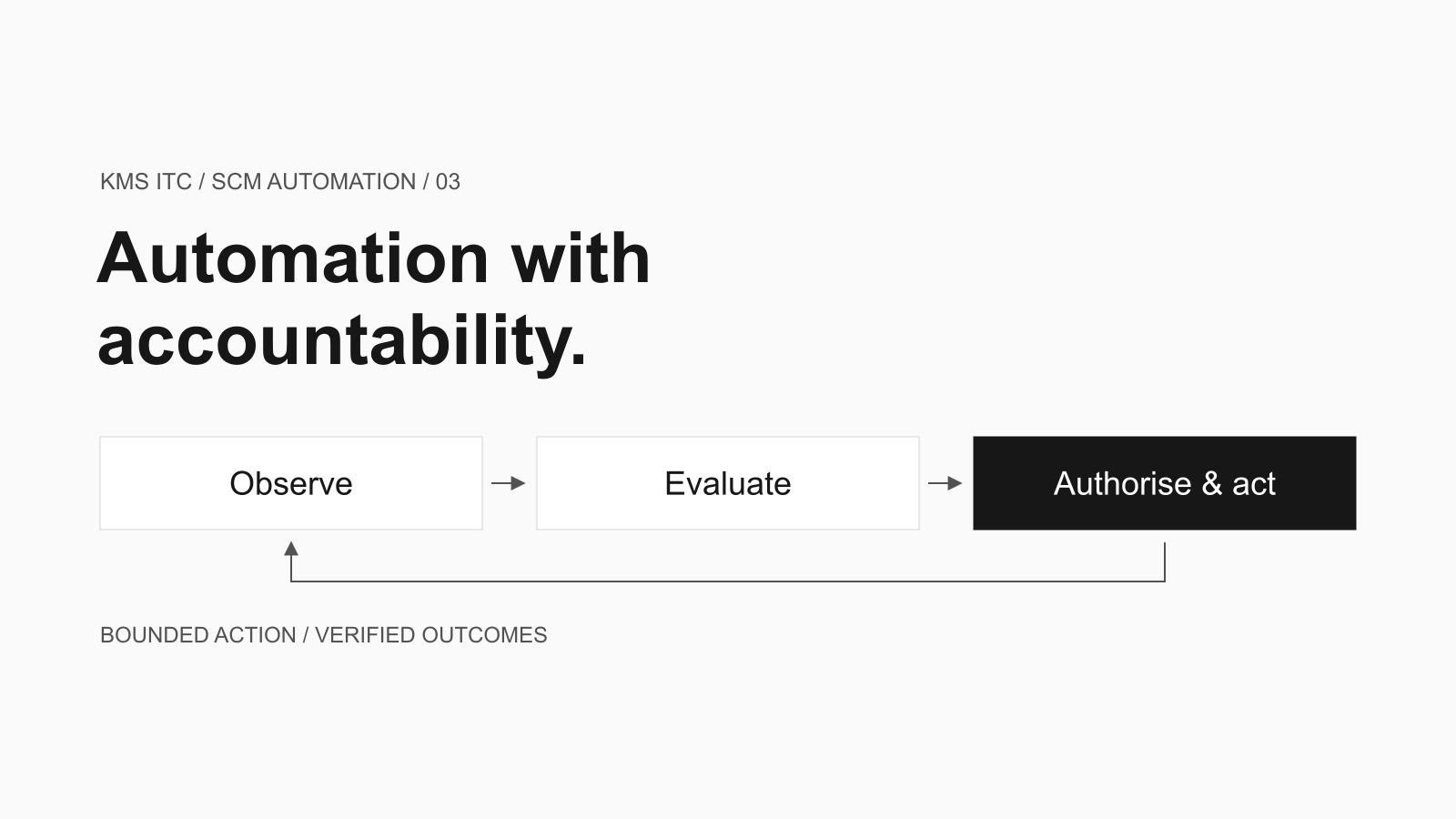
SCM automation: 1. Delivery promises · 2. Feasible scheduling · 3. Accountable automation.
A supplier sends a revised delivery date. Someone reads the message, updates a spreadsheet, calls production and asks sales which customer should be contacted. Automating this sequence looks straightforward until the revised date affects several orders competing for the same remaining capacity.
Now the task involves interpreting evidence, calculating impact, choosing among commercial alternatives and making changes with real consequences. A faster notification is useful. Reliable recovery requires a decision architecture.
Our central recommendation is to build SCM automation around bounded decisions with verifiable outcomes. Each automated action should have a defined trigger, sufficient context, an authority limit and an observable result. AI is one possible component within this architecture; transaction processing, operations research and experienced human judgement remain essential.
The architecture below is a KMS ITC proposal. It combines established integration practices with the planning principles examined in the first two articles. It does not assume that a particular ERP exposes every required interface or supports every scheduling feature.
Start with the decisions that matter
Take one product family and trace a representative order from accepted configuration to customer receipt. Identify the decisions that most often alter cost, timing or customer service. Typical candidates include accepting a delivery promise, releasing a purchase, allocating a scarce component, changing a production sequence and approving premium freight.
For each decision, document its owner, necessary evidence, permissible actions, escalation conditions and outcome measure. Record the real process, including the spreadsheet or phone call that currently bridges a system boundary.
This often reveals improvements that require little automation. An ambiguous approval rule needs an owner. A duplicate data-entry step may be removable. An unreliable material status may need a receiving process change. Automating these weaknesses before resolving them would preserve their ambiguity at greater speed.
Give each business fact a clear owner
A practical implementation usually combines several logical responsibilities:
| Responsibility | Information it should authoritatively maintain |
|---|---|
| Commercial and ERP records | Accepted orders, purchasing commitments, allocations and financial transactions |
| Engineering and product definition | Approved configurations, BOM revisions and applicable change notices |
| Planning and scheduling | Versioned scenarios, constraint models, proposed dates and resource allocations |
| Execution and quality | Actual progress, consumption, downtime, scrap and release or hold decisions |
| Warehouse and logistics | Physical receipt, location, dispatch and transport or delivery events |
| Decision and workflow services | Policies, approvals, action state, exceptions and supporting evidence |
These are ownership boundaries, not mandatory product purchases. One application can own several responsibilities. Conversely, several applications may contribute to a single decision. Define the authority for each field and transition so that integration does not produce two competing masters for the same business state.
A shared vocabulary must distinguish physical receipt, quality acceptance and available-to-use quantity. It must also distinguish estimated, supplier-confirmed and actual dates. Product revision, units of measure, site, time zone and order-line identity should survive every hand-off.
For intercompany traceability, GS1 EPCIS offers a standard for exchanging visibility events; its companion vocabulary gives shared meaning to event values. This is useful where partners need interoperable descriptions of movement and status. It does not calculate a production schedule or make inaccurate observations true. GS1: EPCIS and CBV.
For a small internal pilot, a carefully defined event schema may be sufficient. Use an external standard where interoperability warrants it, rather than making standards adoption a prerequisite for every local improvement.
Separate observation, evaluation, authority and action
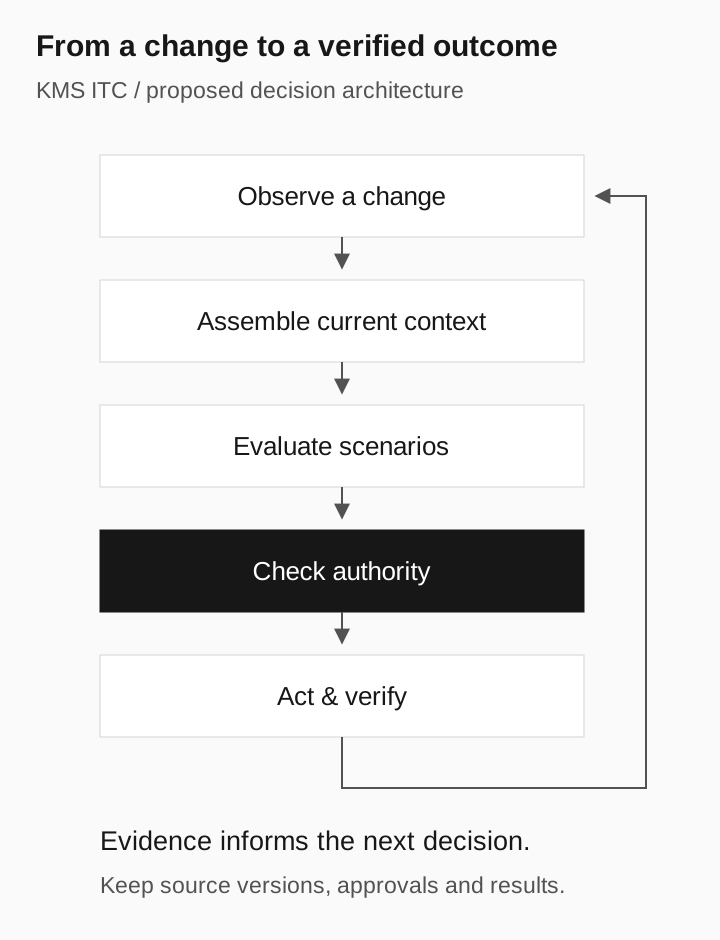
Proposed logical architecture. The stages can run within existing systems or across integrated services.
Observation records what was reported or measured, by whom and when. Preserve both event time and receipt time so that a late-arriving message does not masquerade as a new physical event. Deduplicate repeated events and reconcile corrections.
Context assembles the affected order, product revision, material state, resource reservations and applicable policy. Store source versions and timestamps. A stale planning snapshot should be identifiable before a decision is released.
Evaluation determines the operational impact and compares alternatives using the appropriate mechanism: a query, deterministic rule, planning engine, optimiser or human assessment. Keep scenario calculation separate from changes to live commitments.
Authority checks whether the proposed action is within an existing delegation or needs explicit approval. Apply limits to cumulative exposure where appropriate; dividing one large purchase into several small actions must not circumvent an approval threshold.
Action executes the approved change through a controlled interface. Record a stable request identity, check preconditions, and make retries safe. Verify the resulting business state, including acknowledgement where required.
Evidence and learning connect the action to what happened next. Preserve overridden recommendations and their reasons so that review can distinguish a model weakness from a deliberate management choice.
This is the Intent-to-Evidence method applied to supply chain operations. Its purpose is to make automation accountable at the point where information becomes a real commitment.
Protect the interval between calculation and commitment
Suppose two sales orders are evaluated at the same time. Each sees the same unallocated glass and the same open assembly slot. Each is feasible against its own snapshot. Both cannot necessarily be accepted together.
The reservation or commitment service must resolve that conflict. Depending on the platform, use an atomic reservation, a version-checked update or a serialised commitment process. If the preconditions changed after evaluation, recalculate rather than issue a promise based on obsolete availability. A simulation must not silently consume live capacity; an accepted plan must not silently leave that capacity available to everyone else.
Integration failures create a related problem. An ERP may accept a PO creation request while the network times out before the caller receives the response. Blindly retrying can create a duplicate purchase. Use a persistent request reference and reconcile against the target system before retrying an action whose outcome is unknown.
Across multiple systems, assume partial completion is possible. If a reservation succeeds but a later step fails, use a managed workflow with recovery or compensating actions that respect the business state. A PO already accepted by a supplier may require an authorised cancellation; deleting a local record is not a reversal of that external commitment.
These controls draw on established distributed-systems engineering. They become more important as the number and speed of automated decisions increase.
Match the mechanism to the task
Different technologies solve different parts of the problem:
- Rules and conventional software suit exact checks, arithmetic, validation, routing and known transaction paths.
- Optimisation suits resource allocation and sequencing under explicit constraints and objectives.
- Statistical models can estimate demand, duration or disruption risk where data supports validation.
- Language models can extract proposed facts from correspondence, classify exceptions and draft explanations of evaluated alternatives.
- Human judgement resolves new commercial trade-offs, contested evidence and situations outside delegated policy.
An AI-extracted supplier date should retain its source, ambiguity and review state. “We expect to dispatch Tuesday” is not confirmation that the factory will receive the material Tuesday. A model should not convert one into the other because a form requires a date.
Likewise, an explanation generated by a language model must be grounded in the actual scenario result. It should not invent a feasible schedule or claim that a constrained resource is available. Numerical and constraint checks belong in mechanisms that can be inspected and validated.
Supplier messages and attachments are external evidence. Their contents should never expand the automation’s permissions. A request in a document to bypass approval or use a different payment destination must be processed as data requiring the appropriate business controls.
The question is how much responsibility a mechanism can reliably carry, under which conditions. A language model may materially reduce interpretation effort without receiving authority to purchase, resequence production or change a customer’s promise.
Tesla’s Model 3 ramp: a test of automation judgement
Tesla’s 2019 annual report recounts difficulties ramping fully automated processes during the initial Model 3 production ramp, including battery-module assembly, material flow and general assembly. It says some challenges were addressed by reducing automation and introducing manual or semi-automated processes. This is a historical disclosure, not a description of how all Tesla factories operate today. Tesla 2019 annual report, Risk Factors.
Our interpretation: the proportion of work automated is a poor standalone measure of manufacturing maturity. The relevant test is whether the chosen process can deliver acceptable flow, quality and recovery under real operating conditions. The Tesla–Toyota infographic in Part 1 puts this historical lesson alongside supply-network choices and Toyota’s operating principles.
For an SCM implementation, design the fallback as carefully as the normal path. If an automatic material-matching step cannot identify the correct order revision, it should preserve the evidence and route the exception to an authorised person. If an optimiser cannot produce an acceptable schedule in time, the business needs a controlled way to continue with the last authorised plan where still safe and feasible. Manual intervention must remain traceable so that it can improve the next design iteration.
This does not establish that manual work is generally superior. It establishes a more useful acceptance question: can the complete operating process sustain the required outcome, including its exceptions? Validate that before increasing the scope of delegation.
Walk an exception all the way through
Return to the window order. A supplier changes the expected glass receipt from day 6 to day 9. These dates are hypothetical working-day boundaries, not a production forecast.
The integration records the supplier statement against the correct PO line and revision, then checks whether its meaning is receipt or dispatch. The impact calculation identifies the affected assembly operations and customer orders. It uses current capacity reservations, remaining work and quality prerequisites.
The decision service can then present comparable alternatives:
| Alternative | Evidence required before commitment |
|---|---|
| Expedite the original supply | Supplier-confirmed arrival improvement, freight quote and demonstrated effect on receipt |
| Use an alternative source | Correct specification, qualification, usable lead time and purchase approval |
| Move assembly or add capacity | Approved resources, staffing, tooling, cost and impact on other orders |
| Split the customer delivery | Feasible quantities, additional logistics cost and customer acceptance |
| Revise the delivery promise | A supported new date and the required commercial agreement |
Avoid comparing only the affected order’s result. Moving assembly may displace another customer; expediting can consume a shared freight allowance; substituting stock may deprive another released job. Evaluate the affected set of commitments and show residual risk.
Once a choice is approved, execute it, obtain the relevant acknowledgements and monitor the dependencies that justified it. Keep the original accepted date alongside the revised one. A customer-facing message is one action in this workflow, with its own authority; an internal calculation should not automatically become an external commitment.
Introduce automation through evidence gates
For many organisations, an initial quarter is enough to test one bounded use case, but scope and data condition determine the duration. The following is a suggested sequence, not a delivery guarantee:
Establish the baseline. Select a product family, define the original-promise measure and trace recent late and successful orders. Record recovery costs, decision delays and recurring data defects. Appoint an operational owner and a technical owner.
Build a read-only view. Connect the minimum order, material, capacity and execution evidence needed to explain current exceptions. Reconcile it with source systems and the people doing the work. Do not mistake an attractive dashboard for agreement about the data.
Run in shadow mode. Generate recommendations without changing operations. Compare them with planner decisions and eventual outcomes. Replay historical cases using only information that was available at the time; using later confirmations would overstate performance.
Enable assisted action. Let planners review a proposal, its assumptions and the change it would make. Apply version checks at execution and verify the resulting state. Exercise recovery from duplicate events, stale inputs, timeouts and partial completion.
Delegate a narrow action class. Automate actions only where evidence supports predictable behaviour and the business has specified limits. Examples might include refreshing a non-binding forecast or preparing an internal exception task. Extend authority to purchases or live schedule changes only after their controls and operational outcomes meet agreed acceptance criteria.
Progression should depend on demonstrated accuracy, safe recovery, acceptable workload and ownership of exceptions. Time elapsed alone is insufficient.
Evaluate economic benefit and operational burden together
Measure customer receipt against the original promise, recovery cost, schedule churn and working capital exposure alongside time saved. Also measure new burdens: exception review, data correction, false alarms and ongoing integration maintenance.
Compare similar orders and operating conditions. Where a phased rollout permits, retain a comparable group or period for context. Avoid attributing every improvement to automation when demand mix, staffing or supplier reliability changed at the same time. Record the assumptions behind any benefit estimate and avoid double-counting reduced expediting and reduced labour if they represent the same recovered cost.
The programme should be able to explain which decision improved, why it improved and whether the benefit persists after the novelty of the rollout has passed.
The next stage is continuous, evidence-based replanning
Our forward-looking view is that SCM systems will increasingly maintain linked representations of orders, capabilities, supply, constraints and commitments, then evaluate the consequences of change continuously. The practical advantage will come from faster, better-supported decisions across those relationships.
Digital twins and simulation can support that direction where their scope and fidelity justify the cost. NIST’s manufacturing work emphasises verification, validation and uncertainty quantification as foundations for trustworthy digital twins. A visual representation of a factory is not, by itself, sufficient evidence for a delivery decision. NIST: Digital Twins for Advanced Manufacturing.
We expect three architectural concerns to become more significant: exchanging meaningful evidence across company boundaries, retaining consistency when many decisions occur concurrently, and calibrating forecasts against actual outcomes. Each is a practical engineering and governance problem before it is an AI problem.
A credible first step remains deliberately focused: choose one recurring decision, make its dependencies visible, assign its authority and verify its consequences. Extend that pattern as the organisation earns confidence in the evidence. The long-term opportunity is a supply chain whose commitments remain understandable and defensible even as the operating environment changes.
Research reviewed on 7 October 2026. The architecture, rollout sequence and outlook are KMS ITC recommendations and analysis. They are not claims of measured customer results, guaranteed benefits or confirmed functionality in a specific ERP installation. The historical Tesla example is attributed separately to its public annual report.