
AI Strategy
When a team becomes one person: AI and the minimum viable organisation
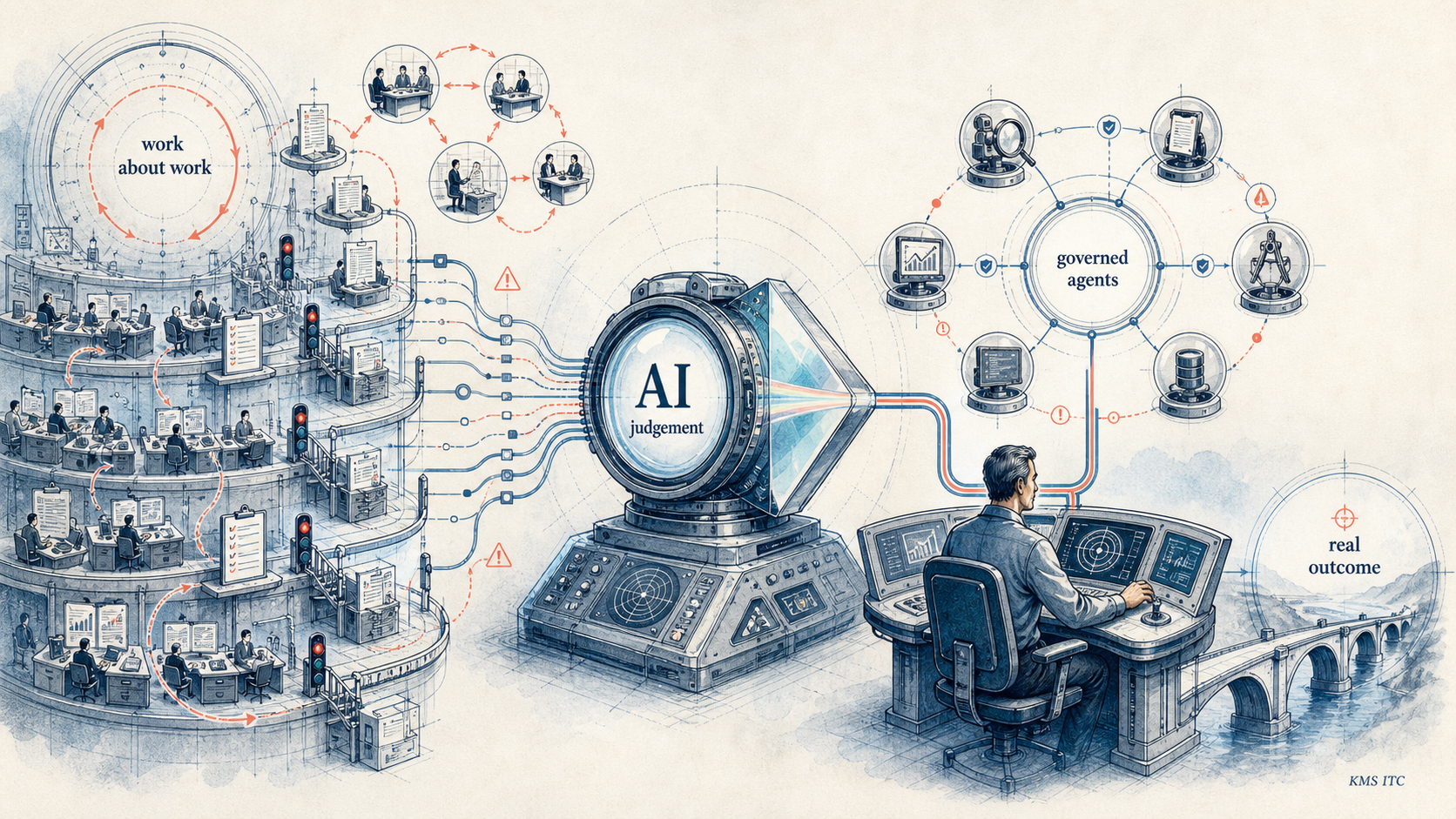
AI is not just making existing teams faster. It is changing the minimum number of people required to deliver an outcome safely and well — and exposing how much organisational work is really work about work.
Paul Graham once wrote:
“The most dangerous way to lose time is not to spend it having fun, but to spend it doing fake work.”
The longer I work in large organisations, the more I understand what he meant.
A project that could technically be completed in a few months can somehow stretch into one or two years. A small delivery team expands across functions, vendors, locations and time zones.
Then the work around the work begins.
Status meetings. Pre-meetings. Steering meetings. Templates. Approvals. Progress reports. Architecture reviews. Risk registers. Stakeholder alignment. Documents prepared mainly for the next meeting.
Every activity appears defensible on its own. Everyone looks busy. Yet the effort spent discussing, reporting, coordinating and demonstrating the work can eventually exceed the effort required to deliver the outcome itself.
This is work about work — a particularly convincing form of fake work.
Fake work does not only waste time. It trains people.
Over time, people become better at anticipating what management wants to hear, completing templates, navigating internal narratives and moving work through processes.
But they may become worse at deciding which problems are worth solving — and at taking one from ambiguity to a real outcome.
That is the uncomfortable part. Bureaucracy is not just an overhead around delivery. It can become the delivery system itself.
Then AI arrives.
AI is changing the delivery unit
Most organisations initially treat AI as a productivity tool: faster coding, faster documentation, faster analysis.
But its deeper impact may be different.
AI is redefining the minimum number of people required to deliver a project.
In the past, a software initiative might require a product manager, business analyst, architect, developers, testers, DevOps engineers, UX specialists and technical writers. This was not always because every role required a full-time person. It was partly because no individual had enough cognitive bandwidth to work effectively across all those domains.
AI changes that constraint.
An experienced person can now use AI to clarify requirements, challenge assumptions, design architecture, generate code and tests, investigate failures, prepare infrastructure, document decisions and review the solution from multiple perspectives.
This is not merely a productivity gain. It is an expansion of scope.
A person who previously owned one part of the delivery chain may now be able to own the entire outcome.
The future team is smaller — but not less skilled
The future delivery team may not be twenty highly specialised people handing work from one function to another.
It may be one or two people with strong end-to-end judgement, supported by governed AI agents and a small number of specialists brought in at critical points.
The key word is judgement.
AI does not simply amplify labour. It amplifies judgement.
In capable hands, it compresses months of delivery into weeks. In weaker hands, it produces errors, complexity, documentation and fake progress at unprecedented speed.
If organisational incentives remain unchanged, AI will not eliminate fake work. It will industrialise it.
The real opportunity is organisational design
The real opportunity is not just to introduce better models.
It is to redesign organisations around smaller teams, clearer ownership, shorter feedback loops and measurable outcomes.
Perhaps one of the most important questions for the AI era is not:
How can AI make our existing team more productive?
It is:
What is the minimum viable organisation required to deliver this outcome safely and well?
In the past, organisations accumulated capability by adding people.
In the future, one person with sound judgement — and a governed system of AI support — may constitute an entire team.
That does not make teams obsolete. It makes ownership harder to hide from.